Public tool - 2026
Agent Workstation
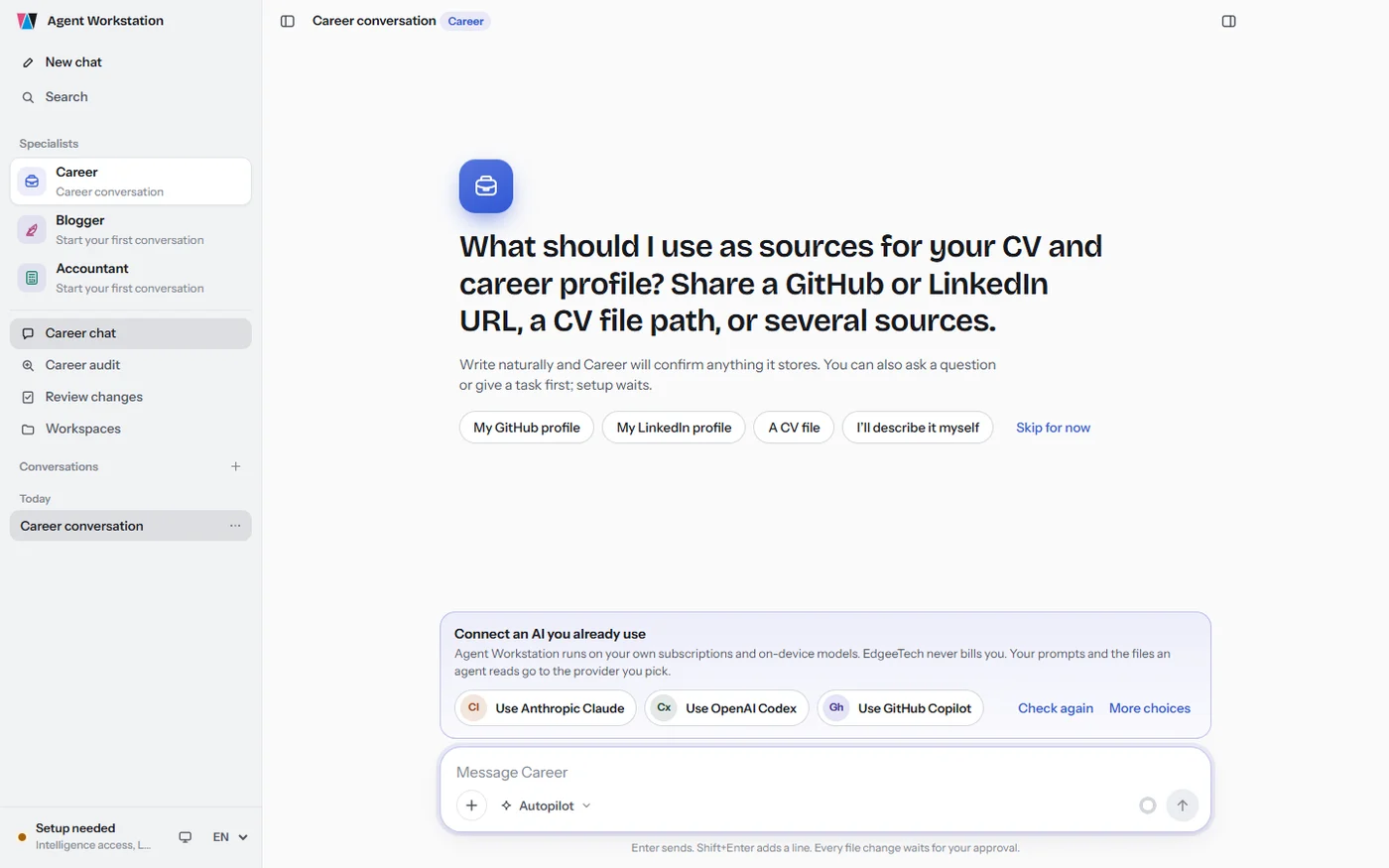
A Windows-first Electron desktop hub that runs specialist AI agents on your own Claude, Codex or Copilot subscription, or local Ollama models, and only writes after you approve an exact diff.
Why It Exists
Most agent tools assume a chatbot in a browser tab, or an API bill that scales with usage. Agent Workstation starts from a narrower assumption instead: the person running it already pays for Claude Code, OpenAI Codex or GitHub Copilot, or would rather run a model locally through Ollama, and EdgeeTech never bills anyone for any of it. The desktop shell exists so specialist agents have somewhere permanent to live, instead of being reconstructed as a fresh prompt every time.
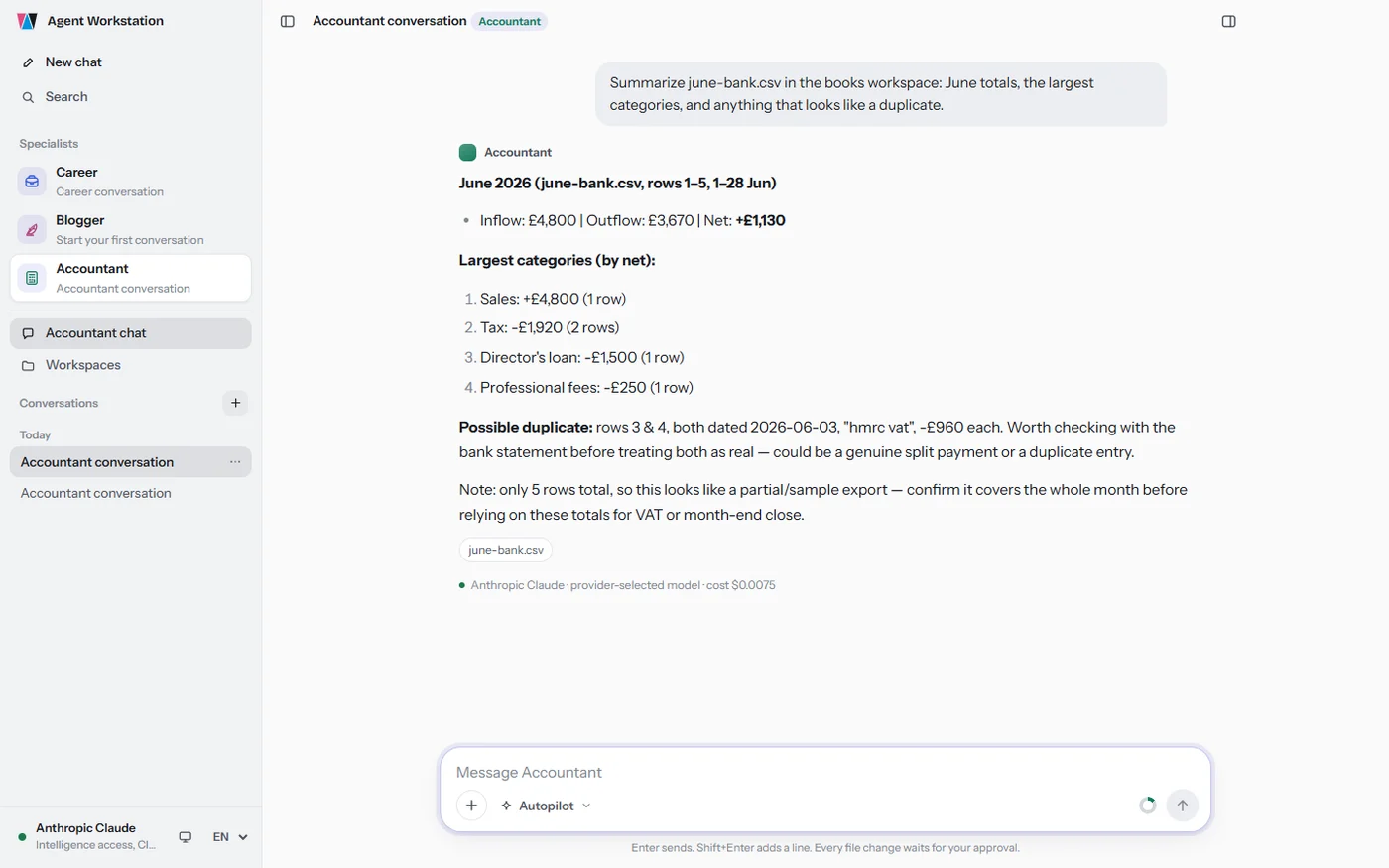
Specialists are declarative files rather than hard-coded behavior: an AGENT.md, an agent.yaml, a RULES.md, a memory/ folder and workflows/. Career, Blogger and an Accountant built around a UK small limited company ship as examples. The Accountant keeps a deterministic statutory filing calendar, summarizes a CSV ledger and sends deadline reminders - it never files or pays anything itself, on purpose.
Native Desktop Shell
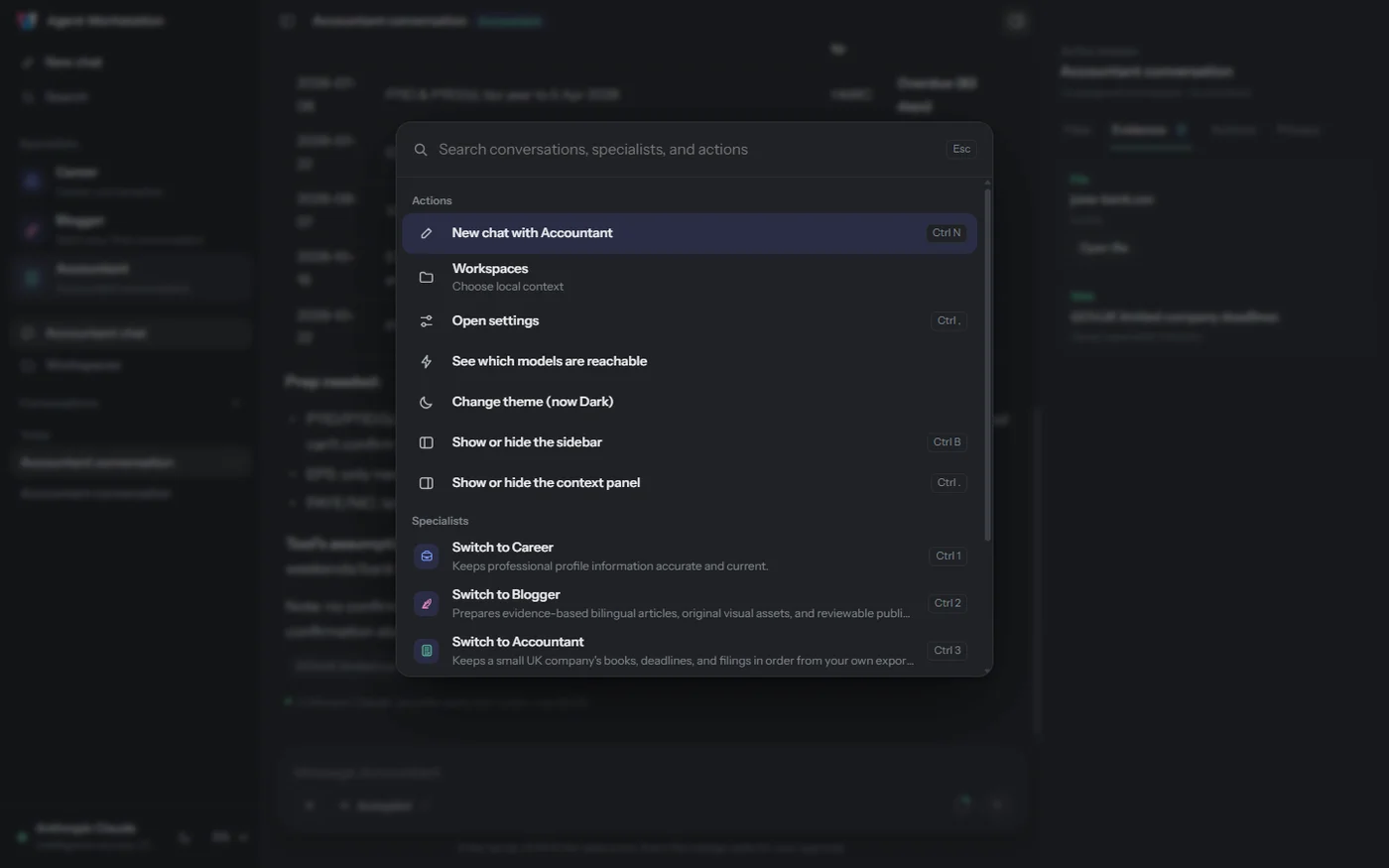
Release v0.2.0 turned the project from a working prototype into something that behaves like a desktop tool: a frameless window with light and dark themes, a command palette on Ctrl+K, a global shortcut to bring it to front, and native notifications when a long-running agent finishes.
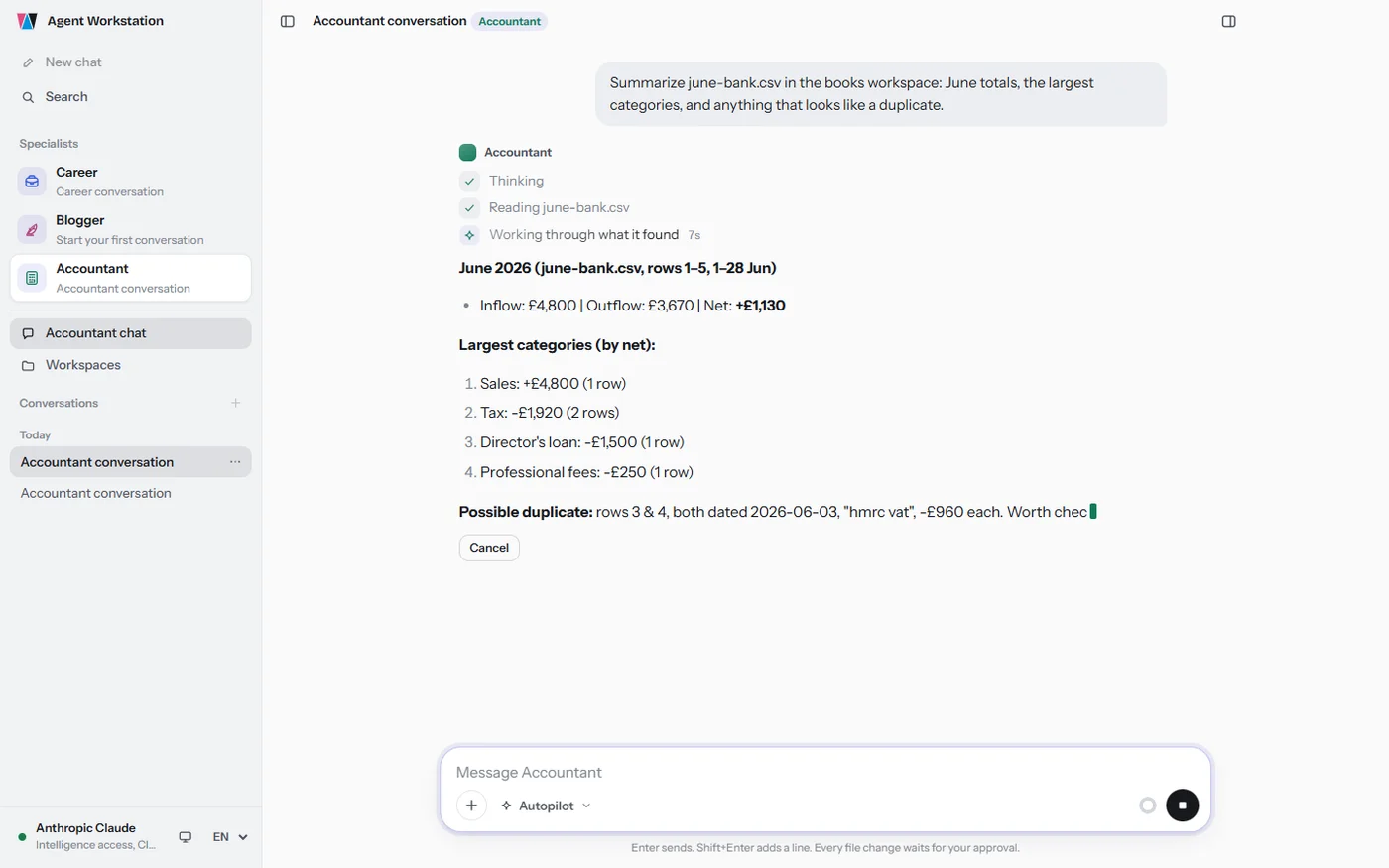
Live Activity, Warm Sessions
While a specialist works, the shell shows each step it takes and streams the reply as it is written, instead of showing a spinner. The same release added warm Claude sessions: measured in live runs, a tool-using answer went from about a minute and a half to about 13 seconds, and cost per answer dropped from $0.05-0.11 to under a cent - mainly by isolating the provider session from the user’s own Claude Code configuration rather than starting cold each time.
Specialists are also portable: any of them can be exported as a Claude Code or Cowork plugin, and the Agent Workstation repository is itself a plugin marketplace (claude plugin marketplace add edgeetech/agentworkstation). A local usage ledger can be imported straight into Taksim with taksim history import --client agentworkstation. The app auto-updates from GitHub Releases; the installer itself is unsigned.
Approval Before Anything Writes
The safety model is deliberately narrow: the model proposes, and the app writes only after a human approves an exact diff. A tool policy gate sits in front of every action, Electron is hardened with a sandboxed renderer, context isolation and a strict CSP, and an evidence panel cites where an answer’s claims came from.
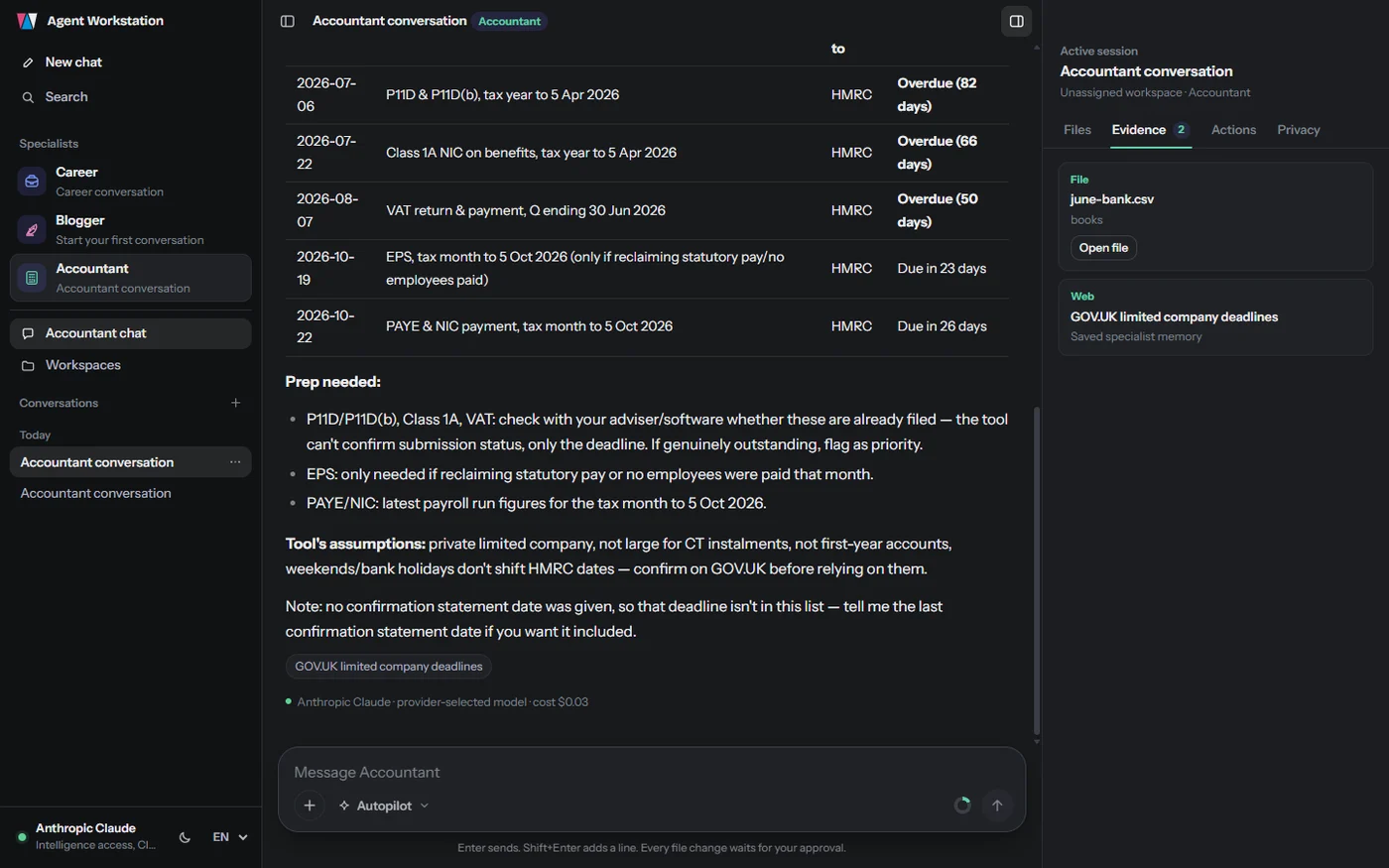
The Accountant specialist is the clearest example of that boundary in practice: it reasons over a ledger and a filing calendar, but the actual filing and payment stay outside its reach.
Where This Sits Next to Cowork
Anthropic’s Cowork plugins now cover the same file-based specialist idea officially, which is a fair reason to ask why this project still exists; the honest answer is that Agent Workstation stays useful for being multi-provider across paid subscriptions and local models, local-first, built on deterministic tools rather than model-only reasoning, and approval-gated on every write.
What I Like About It
Agent Workstation is personal-first: it was built to run my own specialists on my own subscriptions, it’s now open source and in maintenance mode, and EdgeeTech makes no commercial claim on it. Anyone can install it and point it at their own accounts. The part I like most is the constraint that made it interesting in the first place - a specialist is only as trustworthy as the diff a human actually reads before approving it.